

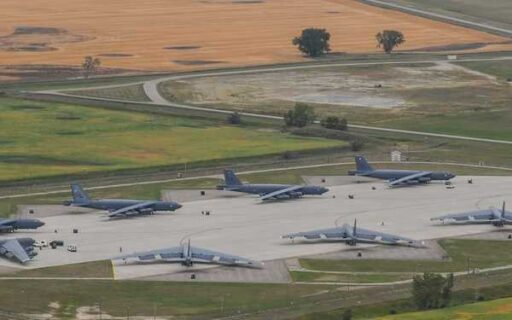
Minot Air Force Base (AFB) in Ward County, North Dakota, is preparing for approximately $5 billion in construction activity spread across the base and its surrounding missile fields over the next ten to fifteen years, making it one of the most consequential and sustained defense construction markets in the Upper Midwest. The programme is anchored by two major nuclear modernisation initiatives: the LGM-35A Sentinel intercontinental ballistic missile, which is replacing the aging Minuteman III system, and the AGM-181 Long-Range Standoff (LRSO) cruise missile, which is being integrated into the base’s B-52H bomber fleet. Sentinel-related construction spans Minot AFB and missile sites across several surrounding counties in North Dakota, is scheduled from fiscal year 2026 through fiscal year 2040, and carries more than $2 billion in dedicated construction funding.
The LRSO programme will contribute an additional five major renovation projects between FY2026 and FY2033, with more than $150 million identified specifically for B-52-related construction works. Together, these two programmes form the structural backbone of the modernisation roadmap, reinforcing Minot’s status as the only dual-wing nuclear installation in the Department of the Air Force, home to both the 5th Bomb Wing’s B-52H Stratofortress bombers and the 91st Missile Wing’s Minuteman III missile force. The base’s total annual economic impact reached $956.7 million for the fiscal year ending September 30, 2025, and its population of more than 11,000 people classifies it as a large Air Force installation by Pentagon standards.
Scale of the Minot AFB Defense Construction
The scale of what is being planned at Minot AFB deserves to be read within the wider context of the United States’ nuclear triad recapitalisation effort, which is arguably the most capital-intensive defence infrastructure programme running anywhere in the country right now. The Sentinel programme, managed by Northrop Grumman under an Air Force contract, is not simply a missile replacement; it involves the wholesale reconstruction of launch facilities, launch control centres, and the hardened underground infrastructure that supports them across multiple bases and missile fields spanning hundreds of miles. Minot’s Sentinel footprint, covering much of north-central North Dakota, is among the largest of any ICBM base. Comparable installations, including F.E. Warren Air Force Base in Wyoming and Malmstrom AFB in Montana, are also receiving Sentinel-related construction investments, but Minot’s dual-wing structure means it is simultaneously absorbing the LRSO bomber upgrade programme, making it the only base in the country carrying both nuclear modernisation tracks concurrently.
Similar large-scale military reconstruction efforts are also underway elsewhere in the United States, including the Tyndall Air Force Base reconstruction project in Florida, where extensive rebuilding is being carried out to restore and modernize critical base infrastructure following catastrophic storm damage. For North Dakota’s construction industry specifically, the economic implications are substantial and long-duration in a way that commodity price cycles, agricultural capital spending or energy sector investment cannot reliably offer. The challenge for regional contractors will be navigating the security clearance requirements, specialised technical scopes and federal procurement processes that defence construction demands, and that gap between regional construction capacity and federal project requirements is exactly what local officials and the Minot Area Chamber EDC will need to address if North Dakota firms are to capture a meaningful share of this work.
Construction Scope, Programme Scale and Workforce Dimensions
Total planned construction: approximately $5 billion across Minot AFB and surrounding missile fields over 10 to 15 years
Sentinel ICBM construction programme: more than $2 billion in funding, FY2026 through FY2040, spanning the base and missile sites across multiple counties
LRSO cruise missile programme: more than $150 million for B-52-related construction, covering five major renovation projects from FY2026 to FY2033
Ongoing base improvement backlog: more than $900 million in prepared construction across roofing, HVAC, paving and facility renovations
Active projects currently managed by the 5th Civil Engineer Squadron: more than 400
Construction activity described by base officials as continuous rather than episodic
Technical hiring: 71 additional technical experts anticipated to be hired on top of existing engineering, operations and emergency services staff
5th Civil Engineer Squadron staffing: 493 funded positions, comprising 350 military members and 143 civilians, covering operations, explosive ordnance disposal, readiness and emergency management, installation management, missile engineering, fire emergency services and engineering
Project timelines for major Sentinel works anticipated to run into the 2040s
Project Fact Sheet
Installation Name: Minot Air Force Base (Minot AFB)
Location: Ward County, North Dakota, approximately 13 miles north of Minot via U.S. Route 83
Installation Classification: Only dual-wing nuclear-capable base in the U.S. Department of the Air Force
Total Planned Construction Value: approximately $5 billion
Primary Modernisation Programme 1: LGM-35A Sentinel ICBM — replacing the Minuteman III system; more than $2 billion in construction funding, FY2026 to FY2040
Primary Modernisation Programme 2: AGM-181 Long-Range Standoff (LRSO) cruise missile — more than $150 million in B-52-related construction, FY2026 to FY2033; five major renovation projects
Ongoing Base Infrastructure Programme: more than $900 million across more than 400 active projects
Construction Scopes: building envelope upgrades, HVAC, roofing, paving, facility renovations, specialised missile field infrastructure, hardened underground facilities, launch facilities, launch control centres
Total Land Area: 24,541 acres, including the wider missile complex
Installation Population: more than 11,000 people
Annual Economic Impact: $956.7 million (fiscal year ending September 30, 2025)
Programme Duration: FY2026 through 2040s
Command: U.S. Air Force Global Strike Command
Project Team
Owner/Client: United States Air Force (Department of the Air Force) — operating under U.S. Air Force Global Strike Command, responsible for the nuclear deterrence mission at Minot AFB
Installation Management: 5th Civil Engineer Squadron — the base engineering unit responsible for overseeing all current and planned construction activity, managing more than 400 active projects and 493 funded positions
Wings in Residence:
5th Bomb Wing — operator of the B-52H Stratofortress fleet, recipient of LRSO-related construction upgrades
91st Missile Wing — operator of the Minuteman III and future Sentinel ICBM force, primary recipient of Sentinel-related missile field construction
Sentinel ICBM Programme Contractor: Northrop Grumman Corporation — prime contractor for the LGM-35A Sentinel ICBM programme under a U.S. Air Force contract covering design, development and installation across multiple missile bases
Regional Economic Development Partner: Minot Area Chamber EDC — identified as a key local coordination body for aligning workforce development, apprenticeship programmes and regional contractor participation with the anticipated construction demand
Federal Oversight: Programme funded through Congressional defence appropriations under the Department of the Air Force’s capital improvement and nuclear modernisation budgets


