

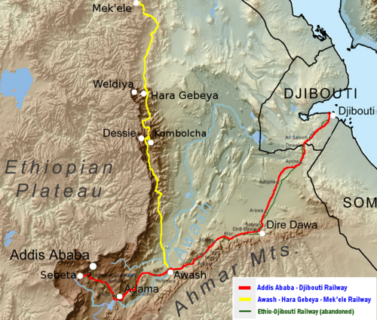
The construction of Awash–Kombolcha–Hara Gebeya Rail has restarted in Ethiopia after years of suspension. Additionally, the $1.7 billion construction scheme revives a strategic 392-kilometre electrified railway. Moreover, the project reconnects central Ethiopia to northern industrial zones. Consequently, authorities aim to restore freight continuity along a previously disrupted national transport spine.
Furthermore, Ethiopian Railways Corporation confirmed mobilization of personnel and equipment. Meanwhile, preparatory works continue across damaged sections and unfinished stations. Additionally, the restart follows improved security conditions in northern regions. Therefore, construction teams now re-enter previously inaccessible sites. Moreover, the revival addresses delays caused by conflict, contract disputes, and infrastructure damage.
According to official updates, the railway remains central to Ethiopia’s logistics transformation strategy. Consequently, stakeholders view the relaunch as a critical recovery milestone. Additionally, planners target a two-year completion timeline based on current projections.
Awash–Kombolcha–Hara Gebeya Rail Construction Restart and Corridor Rehabilitation Works
The Awash–Kombolcha–Hara Gebeya Rail construction restart focuses on full rehabilitation of damaged and incomplete infrastructure. Additionally, engineers assess bridges, tunnels, substations, and control systems across the corridor. Moreover, field teams restore workers’ accommodation and logistics bases to support renewed activity. Consequently, site readiness becomes a priority before large-scale civil works expand.
Furthermore, the project integrates electrified rail systems designed for speeds up to 120 kilometers per hour. Meanwhile, signaling and power control stations undergo technical reassessment. Additionally, maintenance workshops and radio facilities are being revalidated for operational readiness. Therefore, technical teams coordinate system-wide checks before reinstallation continues.
The corridor was originally launched in 2015 under a $1.7 billion EPC contract awarded to Yapı Merkezi. Additionally, Turk Exim Bank provided financing support while SYSTRA MD served as consultant. Moreover, the line was expected to reach completion around 2019/20. However, the northern conflict in 2020 disrupted progress and damaged key infrastructure. Consequently, the project shifted from near-completion to full suspension requiring reassessment.
Furthermore, sections of the railway suffered looting and structural damage during the conflict. Therefore, engineers now conduct fresh technical evaluations before scaling reconstruction. Additionally, procurement teams reorganize supply chains to restore continuity in construction materials delivery.
Awash–Kombolcha–Hara Gebeya Rail Economic Value, Trade Linkages and Legal Challenges
The Awash–Kombolcha–Hara Gebeya Rail carries major economic importance for national and regional trade integration. Additionally, it connects Awash to Kombolcha and Hara Gebeya while linking the Addis Ababa–Djibouti corridor. Moreover, this corridor handles over 95 percent of Ethiopia’s import-export flows according to World Bank estimates. Consequently, improved rail access strengthens national logistics efficiency.
Furthermore, Kombolcha emerges as a key industrial hub within the project’s economic structure. Meanwhile, its industrial park and logistics facilities depend heavily on improved freight connectivity. Additionally, the railway reduces reliance on road transport for northern supply chains. Therefore, transport costs are expected to decline once operations begin.
However, the project faces unresolved commercial and legal risks. Additionally, arbitration proceedings between Ethiopian Railways Corporation and Yapı Merkezi continue to attract attention. Moreover, reports indicate that the London Court of International Arbitration dismissed most of a $979.9 million claim. Consequently, the tribunal ordered partial financial adjustments including repayment of advance funds.
Furthermore, dispute issues include delays, power supply interruptions, and right-of-way compensation. Therefore, legal clarity remains essential for long-term project stability. Meanwhile, authorities continue prioritizing physical reconstruction alongside contract resolution.
The relaunch of the Awash–Kombolcha–Hara Gebeya Rail corridor aligns closely with broader regional rail integration goals highlighted in the proposed East Africa railway development agenda, particularly the initiative discussed on how rail infrastructure is expected to reduce business costs across the region.
As outlined in the earlier analysis of the East Africa rail corridor strategy, improved connectivity between inland production hubs and major trade gateways is central to lowering logistics expenses and boosting cross-border commerce. The Awash–Kombolcha–Hara Gebeya corridor strengthens this vision by reconnecting northern Ethiopia to the Addis Ababa–Djibouti trade artery, thereby reinforcing regional freight efficiency and supporting long-term economic competitiveness.
Project Fact Sheet
Project name: Awash–Kombolcha–Hara Gebeya Railway Construction
Value: $1.7 billion
Length: 392 kilometers
Type: Electrified heavy rail transport construction project
Route: Awash – Kombolcha – Hara Gebeya, Ethiopia
Objective: Restore northern rail connectivity and link to Addis Ababa–Djibouti corridor
Speed design: Up to 120 km/h
Status: Relaunched after multi-year suspension due to conflict and disputes
Original launch: 2015
Expected completion: Approximately two years from restart (government estimate)
Key infrastructure: Bridges, tunnels, substations, control stations, maintenance workshops
Financing: Turk Exim Bank-supported EPC structure
Consultancy: SYSTRA MD
Project Team
Project Owner: Ethiopian Railways Corporation
Policy oversight and coordination: Ministry of Transport and Logistics, Ethiopia
Financial Supervision: Ministry of Finance, Ethiopia
Contractor: Yapı Merkezi
Financier: Turk Exim Bank
Engineering Consultant: SYSTRA MD
Electrification support: Ethiopian Electric Power

