

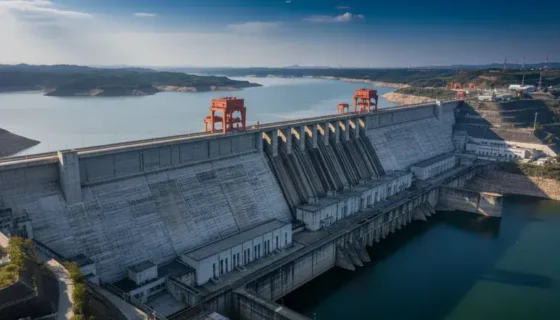
Motuo Project construction officially starts after China launched work on a massive hydropower complex along the Yarlung Tsangpo River in Tibet. Chinese Premier Li Qiang inaugurated the project, confirming the beginning of what is expected to become the world’s largest hydroelectric development. The $167 billion scheme will consist of five cascade dams with a combined installed capacity of 70 GW, nearly three times larger than the current world-leading Three Gorges Dam. Chinese authorities expect the project to begin operations during the 2030s as part of the country’s long-term clean energy and infrastructure expansion strategy.
The Motuo Project represents one of the most ambitious civil engineering undertakings ever attempted in a mountainous region. The hydropower complex will rise in Motuo County within the Tibet Autonomous Region near the border with India. The project area sits along the lower section of the Yarlung Tsangpo River, which later becomes the Brahmaputra River after crossing into India and Bangladesh.
According to Chinese authorities and regional energy analysts, the project will generate about 300 billion kWh annually. That figure equals the United Kingdom’s total annual electricity consumption in 2024. The development will also produce nearly three times the electricity generated annually by the Three Gorges Dam, which currently delivers approximately 100 billion kWh every year.
Motuo Project construction targets the world’s highest hydropower potential
The Yarlung Tsangpo River offers exceptional hydropower conditions due to its dramatic elevation drop through the Great Yarlung Tsangpo Canyon. The river descends nearly 2,000 meters within a 50-kilometer stretch, creating one of the highest hydraulic energy potentials on earth.
The canyon itself ranks among the world’s deepest terrestrial canyons and remains one of China’s most environmentally sensitive regions. Engineers plan to harness this steep descent through a series of five cascading hydropower stations connected by tunnels, reservoirs, and supporting infrastructure.
China established the China Yajiang Group specifically to oversee the Motuo Project and coordinate construction activities across the remote Himalayan terrain. The company will supervise dam construction, tunnel excavation, power generation systems, and associated transmission infrastructure.
Furthermore, the project will require extensive supporting infrastructure beyond the dams themselves. Construction teams are expected to build new access roads, worker camps, transmission corridors, bridges, and logistics facilities throughout southeastern Tibet. The scale of construction activity is also expected to increase demand for cement, steel, heavy equipment, and high-voltage transmission systems across western China.
The project’s 70 GW capacity will surpass every existing hydropower station globally. By comparison, the Three Gorges Dam operates at 22.5 GW, while Brazil and Paraguay’s Itaipu Dam generates about 14 GW. The Motuo Project therefore equals roughly five Itaipu dams operating simultaneously.
Motuo Project raises environmental and regional concerns
Despite its economic and energy significance, the Motuo Project continues to attract environmental and geopolitical scrutiny. The Tibetan-Himalayan Plateau experiences frequent seismic activity, making the region one of the world’s most geologically active zones.
Experts warn that large reservoirs, underground tunnels, and mountain excavation works could increase engineering risks in the region. Environmental groups have also raised concerns regarding biodiversity loss and ecological disruption within the Great Yarlung Tsangpo Canyon, which forms part of China’s largest nature reserve system.
In addition, downstream countries continue to monitor the development closely. The Yarlung Tsangpo River flows into India and Bangladesh as the Brahmaputra River, supporting agriculture, fisheries, and water supply systems across South Asia.
India’s Ministry of External Affairs stated earlier in 2025 that the country would continue assessing developments linked to the project in order to safeguard national interests. Concerns mainly focus on water security, sediment flow, and the possible impact of upstream river regulation during periods of drought or heavy rainfall.
China, however, maintains that the project will not negatively affect downstream countries. Chinese officials also stated that authorities will continue communication with neighboring states regarding river management and hydrological monitoring.
Scientists have additionally referenced previous findings linked to the Three Gorges Dam while discussing the Motuo Project’s potential physical effects. NASA previously confirmed that the massive Three Gorges reservoir slightly altered Earth’s rotation and shifted the planet’s axis due to water redistribution. Although no confirmed models currently exist for the Motuo Project, researchers continue studying the possible geophysical effects of storing significantly larger water volumes at high altitude.
Motuo Project reflects China’s long-term energy and infrastructure strategy
The Motuo Project forms part of China’s broader push toward large-scale renewable energy generation and long-distance power transmission. Beijing continues investing heavily in hydropower, solar, wind, and ultra-high-voltage transmission systems to strengthen energy security while reducing reliance on coal-fired electricity generation.
The project also demonstrates China’s preference for mega infrastructure developments capable of supporting industrial growth, western regional development, and national carbon reduction targets simultaneously.
Construction activity at the Motuo Project is expected to continue for several years as authorities gradually expand work across the five planned cascade dams. Once completed, the development could redefine the global hydropower sector due to its unprecedented scale, output, and engineering complexity.
This project also follows a broader national push toward record-breaking hydropower infrastructure, including the recently advanced Shuangjiangkou hydropower project in Sichuan Province. The 315-meter-tall development recently began storing water and is set to become the world’s tallest dam, highlighting China’s continued investment in large-scale renewable energy construction and complex high-altitude engineering projects.
Project Fact Sheet
Project name: Motuo Project / Yarlung Tsangpo Hydropower Project
Location: Motuo County, Tibet Autonomous Region, China
River: Yarlung Tsangpo River
Project type: Cascade hydropower dam complex
Project cost: $167 billion
Installed capacity: 70 GW
Annual electricity generation: Approximately 300 billion kWh
Number of dams: Five cascade dams
Expected operations: 2030s
Developer: China Yajiang Group
Project significance: Largest hydropower project under construction globally
Key engineering feature: 2,000-meter river descent over 50 kilometers
Strategic purpose: Renewable energy generation and national energy security
Main concerns: Seismic risks, ecological impact, downstream water management
Project Team
Project owner: Government of China
Lead developer: China Yajiang Group
Project oversight: Chinese State Council
Hydropower engineering support: Chinese state hydropower institutes
Construction contractors: Major Chinese state construction and hydropower companies
Transmission infrastructure partners: State-backed ultra-high-voltage grid contractors
Regional stakeholders: Governments of China, India, and Bangladesh
Environmental monitoring authorities: Chinese environmental and water agencies
Project inauguration lead: Chinese Premier Li Qiang


