

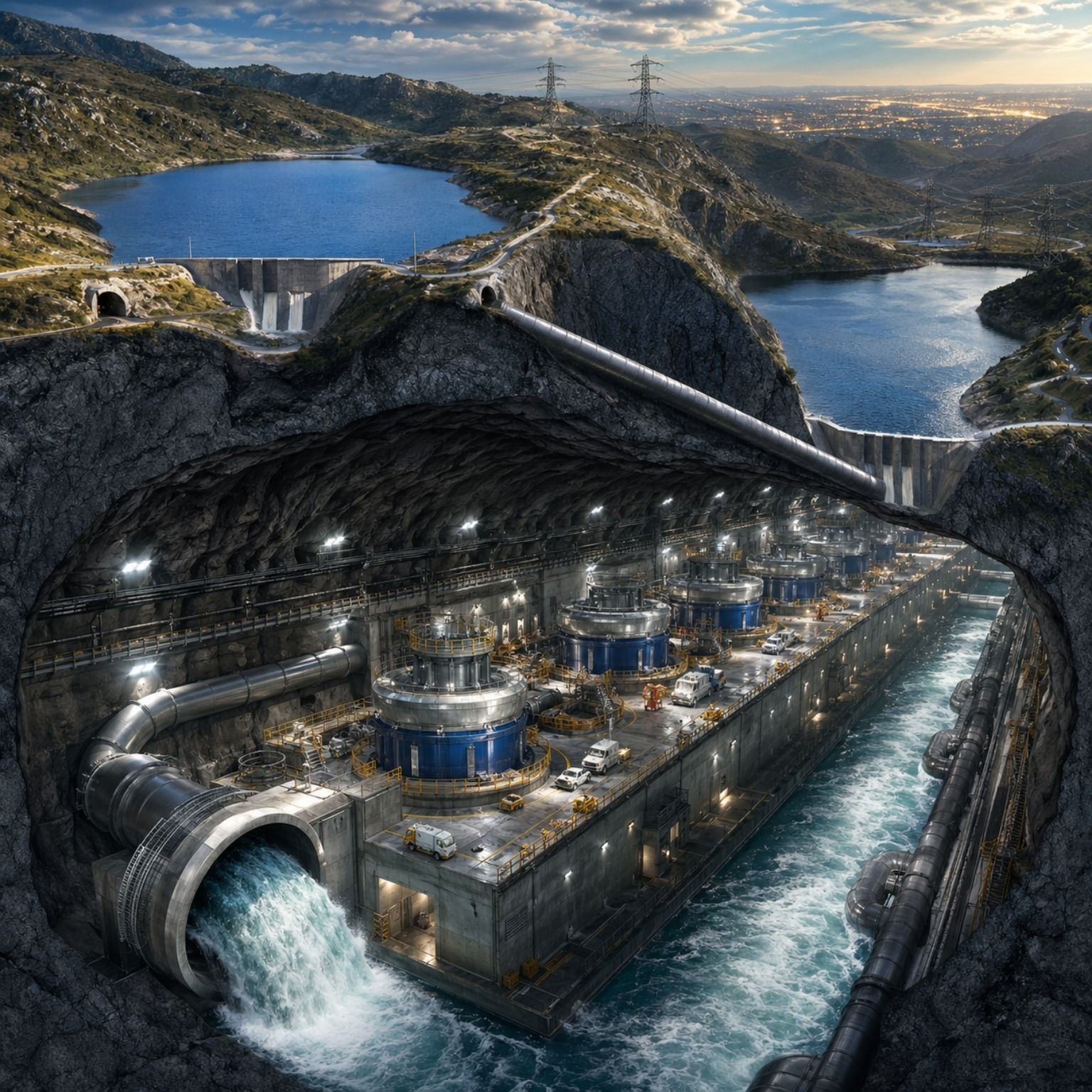
Snowy 2.0 Underground Battery project is advancing as Australia excavates 27 kilometers of tunnels linking two dams. The project integrates a deep underground hydroelectric plant and positions itself as a cornerstone infrastructure for long-duration energy storage supporting wind and solar expansion nationwide.
Australia is converting the Tantangara and Talbingo reservoirs into a single energy system through extensive underground works. Crews are building a new power station roughly 800 meters below ground at Lobs Hole. Consequently, the development is redefining how large-scale storage integrates with renewable generation.
Snowy 2.0 Underground Battery project construction scope
The project expands the historic Snowy Hydroelectric Scheme through reversible pumped hydro technology. It functions as a large-scale energy storage system rather than a conventional plant. Therefore, it stores excess renewable electricity and dispatches it during peak demand periods.
Engineers are installing six reversible pump-turbines inside the underground powerhouse. These turbines generate electricity when water flows downward and pump water uphill during surplus supply. As a result, the system continuously cycles water between reservoirs to balance grid demand.
Moreover, the 27 kilometers of tunnels form the backbone of the system. These tunnels enable controlled water transfer between the two reservoirs. Without them, the integrated storage system would not operate effectively at this scale.
Snowy 2.0 Underground Battery project capacity and scale
The project will deliver 2,200 MW of generation capacity alongside 350 GWh of storage. This capacity places it among the largest energy storage developments globally. In addition, it will supply enough electricity to power approximately three million homes for up to a week.
The scale aligns with projections from Australia’s energy market planning frameworks. These projections highlight the growing need for dispatchable storage as renewable penetration increases. Therefore, the project directly addresses long-duration storage gaps in the national grid.
Furthermore, the infrastructure is designed with a lifespan of up to 150 years. This long-term outlook positions the project as a multi-generational energy asset. It also reinforces its role in supporting the transition to a low-carbon electricity system.
Grid transformation driven by the construction project
The Snowy 2.0 Underground Battery project will significantly enhance grid reliability across Australia. It provides rapid-response generation during supply shortages and supports system stability during renewable variability. Consequently, it reduces dependence on fossil-fuel-based peaking plants.
Additionally, the project allows better utilization of wind and solar generation. Excess electricity generated during low demand periods will be stored instead of curtailed. Later, the stored energy will be released when demand increases or renewable output declines.
Snowy Hydro expects the project to reach completion by the end of 2028. Once operational, it will become a central dispatchable energy source within the national electricity market. Therefore, it will play a critical role in balancing supply and demand across interconnected regions.
The project also attracts global attention due to its engineering complexity and strategic importance. Its scale, depth, and storage capacity position it as a benchmark for future long-duration energy systems. As a result, it is widely regarded as a model for integrating renewables with large-scale storage infrastructure.
Additionally, the broader energy storage landscape in Australia continues to expand, as seen in the Summerfield Battery Project, which highlights parallel investment in grid-scale battery infrastructure supporting renewable integration.
Project Fact Sheet
Project Name: Snowy 2.0 Underground Battery project
Location: Snowy Mountains, New South Wales, Australia
Project Type: Pumped hydro energy storage construction project
Total Cost: Approximately $8 billion
Capacity: 2,200 MW
Energy Storage: 350 GWh
Tunnel Length: 27 kilometers
Powerhouse Depth: 800 meters underground
Reservoirs Connected: Tantangara Dam and Talbingo Reservoir
Turbines: Six reversible pump-turbines
Function: Long-duration energy storage and grid stabilization
Energy Supply Capability: Up to 3 million homes for one week
Design Life: Approximately 150 years
Estimated Completion: 2028
Project Team
Project Owner: Snowy Hydro Limited
Engineering, Procurement, Construction Contractor: Future Generation Joint Venture
Joint Venture Partners:
Tunneling Technology Provider: Herrenknecht AG
Transmission Network Integration: TransGrid
Government Stakeholder: Australian Government
Engineering Scope Includes:
- Tunnel boring and underground excavation
- Powerhouse cavern construction
- Pump-turbine installation
- Hydraulic and electrical system integration
Workforce: Thousands of engineers, geotechnical specialists, and construction workers


