

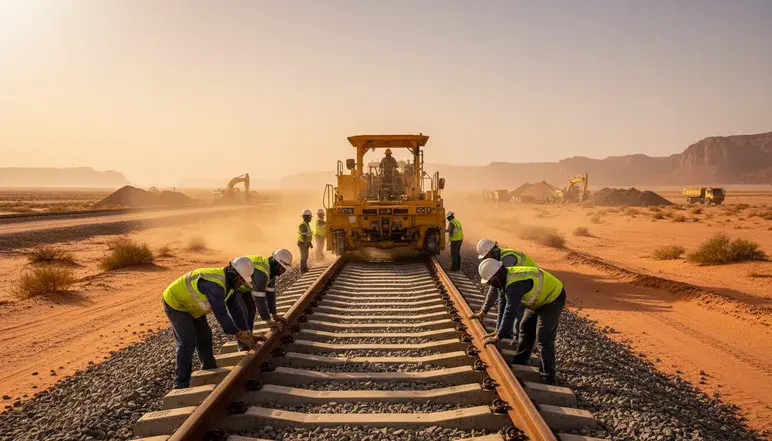
UAE passenger rail project will debut in 2026, marking the country’s first-ever passenger train system across a 1,200 km network. Moreover, the project will connect 11 cities across all seven emirates, transforming mobility in the United Arab Emirates. Consequently, journeys such as Abu Dhabi to Dubai will take about one hour, compared to nearly two hours by road.
UAE passenger rail project transforms desert rail construction
The UAE passenger rail project stands out as one of the most complex railway construction achievements globally. Notably, engineers built approximately 900 km of track in just three years, completing major phases by 2023. Therefore, the pace of delivery highlights a highly coordinated infrastructure strategy.
However, construction teams faced extreme desert conditions throughout the project lifecycle. For instance, ground temperatures reached up to 60°C, while sandstorms frequently covered tracks within minutes. As a result, engineers developed specialized foundations to stabilize shifting conditions.
Additionally, the desert lacked natural ballast materials, forcing contractors to import stone from mountainous regions. Similarly, rails required advanced specifications to withstand thermal expansion caused by sharp temperature fluctuations. Consequently, the project demanded higher engineering precision than conventional railway builds.
Despite these challenges, the project progressed on schedule and within budget. In contrast, many global rail projects face delays and cost overruns. Therefore, the UAE demonstrated that desert rail construction can achieve both speed and efficiency.
UAE passenger rail project anchors $100 Billion regional railway vision
The UAE passenger rail project forms part of a broader Gulf railway initiative valued at $100 billion. Specifically, the Gulf Cooperation Council railway aims to connect six countries, including Saudi Arabia, Oman, and Kuwait. Consequently, the network will enable regional rail travel spanning nearly 2,000 km.
Moreover, a key segment between Abu Dhabi and Dubai cost approximately $13.6 billion for 256 km. As such, the investment averages about $53 million per kilometer, reflecting the premium cost of desert construction. In addition, the project integrates advanced infrastructure standards comparable to leading global rail systems.
Meanwhile, the railway complements an operational freight network launched in 2023. Notably, freight services transport sulfur from inland fields to coastal ports, reducing truck traffic significantly. Therefore, the passenger phase builds on proven logistics performance.
Additionally, the $17 billion Iraq Development Road Project is emerging as a major Asia–Europe connectivity corridor, featuring a 1,200 km rail and highway network designed to transform regional trade flows. While the UAE passenger rail project focuses on high-speed domestic connectivity across seven emirates, Iraq’s road project targets long-haul freight and trade between Asia and Europe through a 1,200 km corridor.
UAE passenger rail project prepares for high-speed passenger operations
The UAE passenger rail project will introduce trains operating at speeds up to 200 km/h with capacity for 400 passengers. Furthermore, onboard features will include Wi-Fi, power outlets, and modern interiors aligned with European standards. As a result, the system aims to provide a competitive alternative to car travel.
Additionally, stations will integrate with urban transit systems, including metro and bus networks. For example, Dubai’s main hub will connect with the Jumeirah Golf Estates Metro Station. Similarly, new stations are under development in Sharjah and Fujairah.
Consequently, commuters will gain the ability to travel daily between emirates without relying on cars. In particular, routes linking Abu Dhabi, Dubai, and Fujairah will significantly reduce travel times. Therefore, the project is expected to reshape commuting patterns nationwide.
Meanwhile, operations will be managed through a partnership involving Etihad Rail and Keolis. Hence, the system will benefit from international rail expertise. Ultimately, the project reflects a strategic national shift toward sustainable and integrated transport infrastructure. As 2026 approaches, the UAE positions itself among global leaders in modern railway development.

Project Fact Sheet
Project Name: UAE Passenger Rail Project
Location: Nationwide, United Arab Emirates
Project Value: $50 Billion (overall program estimate)
Track Length: 1,200 km
Coverage: 11 cities across 7 emirates
Key Cities: Abu Dhabi, Dubai, Sharjah, Fujairah
Top Speed: 200 km/h
Train Capacity: 400 passengers per train
Key Segment Cost: $13.6 billion (Abu Dhabi–Dubai, 256 km)
Construction Milestone: 900 km completed by 2023
Operational Start: 2026 (passenger services)
Key Features: Desert-engineered tracks, high-speed capability, multimodal integration
Freight Status: Operational since 2023
Project Team
Developer: Etihad Rail
Project Owner: Government of the United Arab Emirates
Operator (Passenger Services JV):
Main Construction Contractors (Stage Two Network):
Key Engineering, Procurement and Construction (EPC) Contractors:
Rail Systems & Signaling Technology Providers:
Rolling Stock Suppliers: CAF (passenger rolling stock supplier)
Project Management & Consultancy:
Regulatory & Infrastructure Authorities:
Regional Integration Stakeholders: Gulf Cooperation Council
National rail authorities of:
- Saudi Arabia
- Oman
- Qatar
- Kuwait
- Bahrain


