

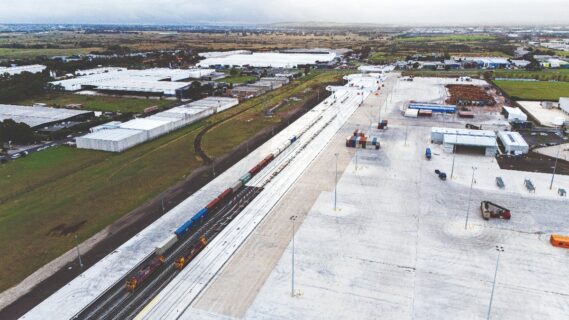
The Melbourne Intermodal Terminal project, led by ACCIONA, is transforming Australia’s freight infrastructure through a $400m investment in Somerton, Victoria. The development comes as global geopolitical tensions, rising fuel costs, and lingering supply chain disruptions continue affecting trade networks worldwide.
Moreover, the project supports Australia’s push for stronger freight resilience, lower logistics costs, and reduced transport emissions. The terminal also strengthens rail connectivity between Melbourne’s industrial zones, interstate freight corridors, and the Port of Melbourne. As demand for efficient freight movement rises, the project is positioning rail transport as a more sustainable alternative to long-haul trucking.
Construction works reached a major milestone after the terminal commenced operations following two years of development. Located within Melbourne’s northern industrial corridor, the facility connects directly to the Hume Highway, Victorian broad-gauge rail, and interstate standard-gauge rail lines. Consequently, freight operators can move goods more efficiently between ports, warehouses, and interstate markets.
Melbourne Intermodal Terminal project supports cleaner freight movement
The Melbourne Intermodal Terminal project reflects growing efforts to move more freight from roads to rail. According to the Australasian Railway Association, rail freight produces substantially lower carbon emissions than road transport per tone kilometer traveled. Therefore, the project supports Australia’s target of achieving net-zero greenhouse gas emissions by 2050.
The terminal also addresses increasing congestion around Melbourne’s freight corridors. Imported goods can now move directly from the Port of Melbourne to Somerton by rail instead of relying entirely on trucks. As a result, freight companies can avoid toll roads, city congestion, and rising diesel costs.
Intermodal Terminal Company Chair John Fullerton said strategically positioned intermodal terminals improve supply chain productivity by enabling seamless freight transfers between rail, road, and shipping networks. He also noted that governments and logistics providers increasingly favor rail because of its environmental and operational advantages.
The facility includes advanced electric rail-mounted gantry cranes capable of loading and unloading between 32 and 36 containers each hour. Additionally, the cranes regenerate electricity during lifting operations, improving energy efficiency across the terminal.
ACCIONA completed more than 30 hectares of concrete hardstands during the construction phase. The terminal also includes customs-bonded storage, container washing facilities, fumigation areas, and repair infrastructure. Consequently, the project functions as a fully integrated freight logistics hub rather than a conventional rail depot.
Melbourne Intermodal Terminal project boosts national supply chain capacity
The Melbourne Intermodal Terminal project forms part of the wider Melbourne Intermodal and Industrial Exchange precinct valued at $1.6bn. The broader development combines industrial warehousing, freight handling infrastructure, and logistics services within one integrated estate.
The terminal occupies a strategic freight location only 20 kilometers from the Port of Melbourne. Furthermore, around 20% of Victoria’s containerized freight volumes move within close proximity to the site. Industry stakeholders believe the location will reduce transfer costs and improve freight efficiency across southeastern Australia.
Port of Melbourne has already introduced incentives encouraging operators to move more containers by rail through the terminal. The incentive program supports the use of rail shuttle services linking the port and the MIT during its operational ramp-up period.
Since operations commenced, more than 10,000 TEUs have moved through the facility. These shipments include imported consumer goods, manufactured exports, and timber products transported between regional Victoria and Melbourne’s port infrastructure.
Southern Shorthaul Railroad currently operates 600-meter rail shuttle services connecting the terminal with port stevedoring facilities. Meanwhile, Aurizon has signed a long-term agreement to use the facility for containerized freight handling over the next nine years.
The terminal initially targets annual capacity of one million TEUs, including both interstate and port shuttle freight volumes. Future expansion phases could support freight growth through the late 2050s. Moreover, the project aligns with the Australian Government’s Melbourne-Brisbane Inland Rail corridor planned for completion later this decade.
Intermodal Terminal Company Chief Executive Officer Mishkel Maharaj said the facility allows all freight owners to benefit from rail logistics through its open-access operating model. Unlike several competing terminals, the MIT serves multiple freight operators instead of a single logistics company.
The Melbourne Intermodal Terminal project therefore represents more than freight infrastructure. Instead, it demonstrates how modern construction projects can strengthen supply chains, support exporters, and reduce transport emissions simultaneously.
The project complements Melbourne’s wider transport infrastructure expansion, including the Suburban Rail Loop East development currently underway across the city. While the MIT focuses on improving freight efficiency and shifting cargo from roads to rail, the Suburban Rail Loop project is strengthening Melbourne’s passenger transport network through major tunneling, station, and power infrastructure works.
Recently, WSP and Beon Energy Solutions advanced detailed designs for critical Bulk Power Supply Points supporting the Suburban Rail Loop East corridor between Cheltenham and Box Hill. Together, both projects highlight how Victoria is investing simultaneously in freight and passenger rail infrastructure to reduce congestion, improve connectivity, and support long-term urban growth.
Project Fact Sheet
Project name: Melbourne Intermodal Terminal (MIT)
Location: Somerton, Melbourne, Victoria, Australia
Project value: $400 million
Broader development value: $1.6bn
Project type: Intermodal freight terminal and logistics hub
Lead contractor: ACCIONA
Project owner: Intermodal Terminal Company (ITC)
Investment backing: Aware Super
Industrial precinct: Melbourne Intermodal and Industrial Exchange (MIIX)
Site size: 45 hectares
Concrete hardstands: More than 30 hectares
Initial annual capacity: 1 million TEUs
Interstate freight allocation: 650,000 TEUs annually
Port shuttle allocation: 350,000 TEUs annually
Rail connections: Victorian broad-gauge and interstate standard-gauge networks
Port connection: Port of Melbourne
Key equipment: Electric rail-mounted gantry cranes
Crane handling capacity: 32–36 containers per hour
Future connectivity: Melbourne-Brisbane Inland Rail corridor
Key sustainability feature: Reduced truck congestion and lower carbon emissions
Project Team
Project owner: Intermodal Terminal Company (ITC)
Lead construction contractor: ACCIONA
Investment partner: Aware Super
Industrial development partner: Aware Real Estate
Investment management partner: Barings
Rail infrastructure coordination: Australian Rail Track Corporation (ARTC)
Rail freight operator: Southern Shorthaul Railroad (SSR)
Long-term freight rail partner: Aurizon
Port authority partner: Port of Melbourne
Stevedoring partners: Patrick Terminals and DP World
Terminal operations manager: Intermodal Terminal Company
Industry association: Australasian Railway Association
Government stakeholders: Victorian Government and Australian Federal Government agencies


