

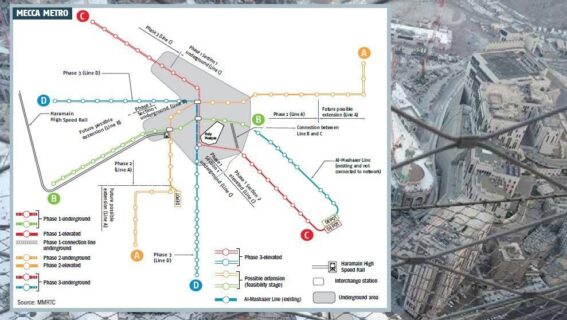
Saudi Arabia tenders Mecca metro design as the Kingdom accelerates plans for a large-scale urban rail system in Makkah. The project targets transformative mobility for millions of annual pilgrims. It also aims to ease severe congestion during peak Hajj and Umrah periods. Authorities have moved the scheme into its formal design and feasibility phase.
Moreover, the programme introduces a structured roadmap toward a four-line metro network. Initial estimates place Phase 1 at around $8 billion. The full system may reach $16.5 billion in total investment. Consequently, the project ranks among the most significant transport upgrades in the holy city.
Mecca metro design Phase 1 expansion framework
Mecca metro design to advance the first implementation stage of the network. Phase 1 focuses on two priority lines, identified as Lines B and C. These corridors will connect key pilgrimage zones and high-demand urban districts. Additionally, planners aim to improve accessibility between transport hubs and religious sites.
Engineering consultants are refining alignments and station locations. They also assess passenger demand during peak seasonal surges. Furthermore, the design prioritizes integration with bus systems and pedestrian corridors. This approach ensures smoother passenger distribution across Mecca.
The initial budget for Phase 1 stands at approximately $8 billion. It covers feasibility studies, preliminary engineering, and early system planning. However, final costs may adjust based on technical refinement. The design stage therefore carries significant influence over future construction efficiency.
Mecca metro design and network cost structure
Mecca metro design within a wider investment framework targeting a four-line metro system. The complete network is estimated at up to $16.5 billion. This expansion includes future lines beyond the initial two corridors.
In addition, the broader design vision supports long-term urban growth in Makkah. Planners focus on scalable infrastructure that accommodates rising pilgrim volumes. The system will also enhance emergency evacuation capacity during high-density events.
French engineering firm Systra previously completed preliminary design work for Lines B and C. The company now updates feasibility studies for the revised scope. Meanwhile, Ernst & Young supports financial and economic structuring. Watson Farley & Williams provides legal advisory input for governance and compliance frameworks.
Moreover, collaboration between technical and financial advisors strengthens project bankability. It also ensures alignment between engineering design and investment strategy. As a result, authorities expect a more streamlined procurement pathway for future phases.
Delivery strategy and integrated mobility transformation
The metro project advances through a phased delivery model. Authorities prioritize design validation before construction procurement begins. Consequently, consultants play a central role in shaping final technical specifications.
The system design emphasizes high-capacity movement during peak religious seasons. It also focuses on reducing road congestion in central Makkah. Additionally, planners evaluate digital signaling systems and automated operations for efficiency.
Environmental considerations remain integral to planning decisions. Engineers assess urban density constraints and geological conditions across proposed corridors. Furthermore, safety standards address extreme crowd management scenarios.
Once finalized, the design framework will guide contractor selection and construction sequencing. It will also define interoperability across all transport modes. Therefore, the metro becomes a backbone for integrated pilgrimage mobility.
The ongoing development of the Mecca Metro design aligns closely with Saudi Arabia’s wider urban rail expansion strategy, particularly the rapid progress seen in Riyadh’s metro system. Recently, the Riyadh Metro Western Station reached full operational completion, marking a key milestone in the $23 billion capital transit network. That project demonstrated how large-scale automated metro systems can successfully integrate intermodal hubs, manage high passenger volumes, and support Vision 2030 mobility goals.
Similarly, the planned Mecca Metro aims to adopt comparable design principles, including high-capacity corridors, seamless multimodal connectivity, and congestion reduction in dense urban environments. Consequently, lessons from Riyadh’s execution are expected to inform design refinement and delivery sequencing for Makkah’s forthcoming rail network.
Project Fact Sheet
Project name: Mecca Metro Design and Development Programme
Location: Makkah, Kingdom of Saudi Arabia
Project type: Urban metro rail design and future construction programme
Number of stations: 89
Current stage: Feasibility and detailed design tender phase
Phase 1 budget: Approximately $8 billion
Total network budget: Up to $16.5 billion
Network scope: Four planned metro lines A to D (initial focus on Lines B and C)
Key objective: Reduce congestion and improve pilgrimage transport efficiency
System type: High-capacity urban rail transit network
Integration plan: Bus networks, pedestrian links, and transport hubs
Project Team
Project owner: Saudi transport and infrastructure authorities
Strategic oversight: Royal Commission for Makkah City and Holy Sites
Transport regulator: Transport General Authority, Saudi Arabia
Lead engineering consultant: Systra (France)
Financial advisor: Ernst & Young (global advisory services)
Legal advisor: Watson Farley & Williams (international law firm)
Urban integration planners: Saudi municipal and transport coordination bodies
Systems and rail specialists: International rail technology and signaling consultants (to be appointed)
Stakeholders: Hajj and Umrah service coordination agencies and city development authorities


