

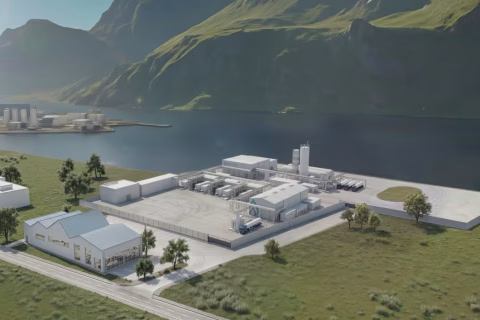
Ethiopia Energy Project advances after China’s Ming Yang secures a $15 billion renewable energy investment license in Ethiopia. Moreover, the program integrates 2.8GW solar, wind power, green hydrogen, and ammonia production systems. The investment rose from $10 billion agreement to nearly $15 billion after expansion approval. It strengthens Ethiopia’s industrialization and energy security goals across multiple regions. Ethiopian Investment Commission approved the license following the Invest in Ethiopia forum.
Ethiopia Energy Project: Phase One Solar and Wind Construction Drive
Phase one allocates $7.47 billion for 8.4GW renewable capacity across three regions. It includes 5.4GW wind and 2.8GW solar PV installations under large-scale construction. Developers prioritize grid integration and transmission expansion to support national demand growth. Ming Yang coordinates site selection across South Omo, Afar and Somali regions. Construction sequencing aligns renewable clusters with grid readiness requirements.
The project strengthens Ethiopia’s grid resilience through distributed renewable generation hubs. It also reduces reliance on imported fossil fuels in power generation systems. Solar deployment improves long-term energy access in rural communities. Wind corridors complement solar output for balanced renewable generation.
Ethiopia Energy Project: Green Hydrogen and Ammonia Industrial Buildout
Phase two invests $7.3 billion in hydrogen, ammonia and manufacturing infrastructure. Facilities produce green ammonia for export markets and industrial fertilizer supply chains. Moreover, electrolysers convert renewable electricity into hydrogen across integrated production hubs. Furthermore, the project reduces fossil fuel dependence in fertilizer production systems. It also expands technology transfer and industrial job creation in Ethiopia.
Ammonia output supports fertilizer production and regional agricultural supply chains. Thus, hydrogen infrastructure positions Ethiopia for future export energy markets. The industrial hubs integrate energy, manufacturing and export logistics systems. Consequently, this integration improves efficiency across the entire value chain.
Integrated Delivery, Financing and Construction Outlook
Overall investment reaches nearly $15 billion across phased renewable industrial development. Execution depends on financing coordination, permitting and infrastructure alignment. Ethiopia strengthens position as a regional clean energy hub. Multi-stage rollout aligns renewable generation with industrial demand growth. On the other hand, transport corridors support export of green ammonia to international markets.
This project enables skills development and local industrial capacity building. Moreover, development follows sustainability standards and renewable integration guidelines. Investors expect phased commissioning to reduce construction and operational risks. Consequently, Ethiopia aims to become a continental leader in green industrial exports. Furthermore, regional integration may also enhance cross-border energy trade within East Africa. While policy coordination ensures alignment between energy transition and industrial policy goals, grid modernization remains essential for stable renewable integration at scale. Therefore, this project signals major African green industrial shift.
The Ethiopia Energy Project also reflects East Africa’s accelerating investment in hydrogen infrastructure following earlier regional initiatives such as the $500 Million Kenya Green Hydrogen Plant Project to be Set up by HDF Energy. Both developments highlight growing momentum behind renewable-powered hydrogen and ammonia production across the region, particularly as governments pursue industrial decarbonisation and export-oriented clean energy strategies.
Project Fact Sheet
Name: Ethiopia Energy Project – Integrated Renewable, Hydrogen and Ammonia Program
Total Investment: $14.1 billion expanding to nearly $15 billion
Phase One: $7.47 billion for 8.4GW renewable energy capacity
Generation Mix: 5.4GW wind and 2.8GW solar PV
Phase Two: $7.3 billion for green hydrogen, ammonia and manufacturing
Locations: South Omo, Afar and Somali regions of Ethiopia
Developer: Ming Yang Smart Energy Group
Regulator: Ethiopian Investment Commission (EIC)
Status: Investment license approved, early construction planning underway
Financing Structure: Mixed foreign direct investment and development-linked funding sources.
Strategic Outcome: Industrialization, export growth and energy security enhancement.
Construction Phasing: Multi-stage rollout aligns renewable generation with industrial demand growth.
Logistics Network: Transport corridors support export of green ammonia to international markets.
Technology Transfer: Project enables skills development and local industrial capacity building.
Environmental Compliance: Development follows sustainability standards and renewable integration guidelines.
Coordination Framework: National agencies align energy policy, investment and infrastructure delivery.
Economic Impact: Expected boost in exports, employment and regional industrialization capacity.
Key Outputs: Electricity, green hydrogen, green ammonia, industrial equipment
Project Team
Project Owner: Government of Ethiopia
Investment Authority: Ethiopian Investment Commission
Developer: Ming Yang Smart Energy Group
Utility Partner: Ethiopian Electric Power
Regional Support: South Omo, Afar and Somali authorities f
Engineering Contractors: EPC firms
Oversight Ministries: Energy and finance ministries


