

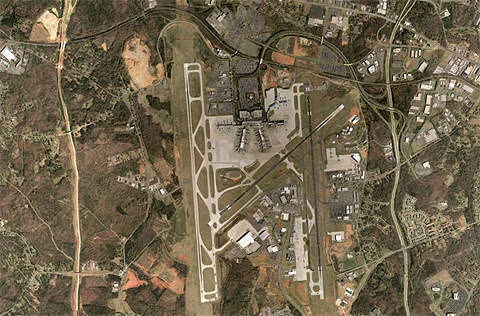
Construction is underway on a new fourth parallel runway project at Charlotte Douglas international airport. However, the project is being deemed to be one of a kind. A new partnership between the airport and UNC Charlotte is bringing cutting edge technology to one of the airport’s biggest expansion projects. “We want to be doing cutting edge research that really capitalizes on this partnership to advance the research that addresses the needs and challenges of today’s airports, today’s aviation industry,” Professor of Civil Engineering Technology & Construction Management Dr. Tara Cavalline said.
Through the partnership, the airport is launching an advanced “digital twin” program. It is one that will embed sensors directly into the pavement to collect real-time data. The goal to better understand how runways perform over time, improving safety, efficiency, and long-term maintenance.
“This instrumentation and digital-twin project grew out of a strong partnership with UNC Charlotte, where the airport serves as a living laboratory for students,” Airport Chief Infrastructure Officer Jack Christine said in a statement. The partnership is an opportunity for researchers and students to work on a real life project and gain real world experience.
Airport projects across the United States are steadily and gradually advancing as various states aim to bolster the number of passengers their airports can accommodate. One such project entailed the $1.72bn Terminal Modernization Program (TMP) at Pittsburgh International Airport. It was an infrastructure redevelopment project focused on updating terminal facilities and operations. The programme fully opened to the public on November 18, 2025, ahead of the holiday travel period.
Scope of Implementation on the Charlotte Douglas International Airport Runway Project
The Charlotte Douglas international airport runway project stems from the airport’s 2016 Master Plan as the airport continues to see growth. In 2025 alone, CLT recorded more than 574,000 aircraft operations, ranking seventh in the world. Here are some of the key details regarding the scope on the fourth runway:
Dimensions: 10,000 ft. x 150 ft.
Location: Situated on the western side of the airport between existing runways.
Opening Date: Scheduled for fall 2027.
Infrastructure: Includes two new End-Around Taxiways (North/NEAT and South/SEAT). Also a new Aircraft Rescue and Firefighting station.
Technology: The project features a first-of-its-kind “Smart Runway” with built-in digital twin instrumentation, developed with UNCC.
Purpose: To manage approximately 1,800+ daily arrivals and departures and boost efficiency.
Once complete, the runway is expected to be a major component of the airport’s expansion to manage demands. Furthermore, it is often referred to as part of the “CLT 2027” or “destination CLT” initiatives.
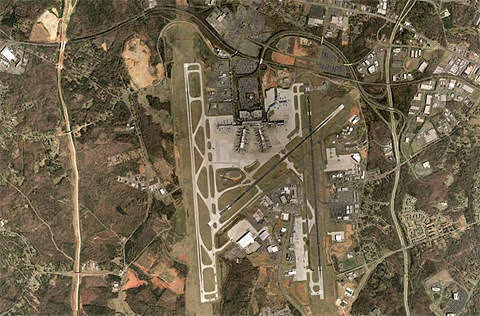
Project Overview
- Project Name: Fourth Parallel Runway Project (CLT 2027 / Destination CLT)
- Project Type: Airport runway expansion
- Value: ~$1 billion
- Purpose: Increase airfield capacity and operational efficiency
- Status: Under construction
Key Stakeholders
- Airport Operator: Charlotte Douglas International Airport
- Academic Partner: University of North Carolina at Charlotte
- Key Figures: Tara Cavalline, Jack Christine
Location
- City: Charlotte
- State: North Carolina
- Country: United States
Scope
- New 10,000 ft x 150 ft parallel runway
- Two End-Around Taxiways (North/NEAT and South/SEAT)
- New Aircraft Rescue and Firefighting facility
Funding / Delivery Model
- Airport-led capital expansion program
- Integrated with long-term master planning (2016 Master Plan)
- Collaboration with academic research partner
Status
- Construction underway
- Target completion: Fall 2027
- Part of broader “Destination CLT” initiative
Key Risks & Challenges
- Integration within active high-traffic airport
- Construction coordination and safety management
- Technology deployment within critical infrastructure
Strategic Significance
- Supports ~1,800+ daily aircraft movements
- Enhances global airport ranking and capacity
- Strengthens long-term aviation infrastructure growth
Key Features
- “Smart Runway” with embedded sensors
- Digital twin technology for real-time performance monitoring
- First-of-its-kind research-integrated runway system


