


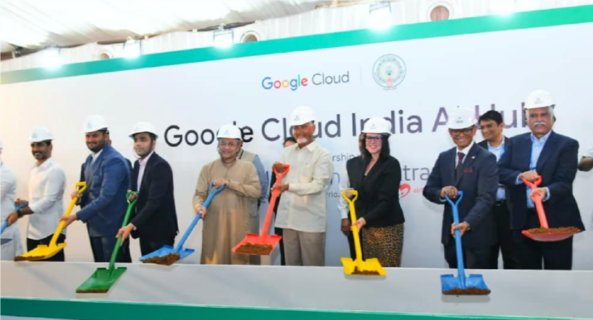
Google AI Infrastructure project has officially entered construction in Visakhapatnam, marking a major milestone in India’s digital infrastructure expansion. The $15 billion development introduces a gigawatt-scale AI ecosystem combining data centers, subsea connectivity, and clean energy systems. Consequently, the project reinforces the country’s position in the global artificial intelligence infrastructure race.
Moreover, the project is being delivered in partnership with AdaniConneX and Nxtra by Airtel. It also aligns with the national “Viksit Bharat 2047” vision. Therefore, the construction effort extends beyond facilities to a broader industrial transformation.
Google AI Infrastructure project anchors Vizag construction hub
Construction activities have commenced in Tarluvada, Visakhapatnam, within India. The site will host three large-scale data center campuses forming the core of the AI hub. Additionally, contractors are mobilizing resources for civil works, energy systems, and connectivity infrastructure. Meanwhile, the project introduces India’s first gigawatt-scale AI data center cluster in a single location. This scale requires extensive power systems and advanced cooling technologies. As a result, engineering complexity remains high across all construction phases.
Furthermore, three subsea cable systems will land in Visakhapatnam to support global connectivity. These systems will enhance data transfer speeds and reliability. Consequently, the city is emerging as a critical digital gateway. At the same time, supporting infrastructure such as substations and fiber networks is under development. The America-India Connect initiative will expand fiber-optic capacity nationwide. Therefore, the project integrates both local and international connectivity.
Notably, government stakeholders are actively supporting the development. Officials highlighted its alignment with national technology and infrastructure goals. Hence, regulatory and policy backing is expected to accelerate implementation.
Google AI Infrastructure project expands industrial ecosystem
Beyond construction, the project is designed to catalyze a national AI industrial ecosystem. It connects suppliers, contractors, and technology providers into a unified value chain. As a result, local industries are expected to benefit from increased participation.
In parallel, a local-first procurement strategy is being adopted. This approach prioritizes regional small and medium enterprises. Therefore, capacity building within the construction and technology sectors is being strengthened. Additionally, the Bharat AI Shakti Conclave was held alongside the groundbreaking ceremony. The event brought together stakeholders to align on infrastructure delivery. Consequently, collaboration across sectors is being enhanced.
Moreover, workforce development programs are being implemented. Training initiatives target construction, welding, and facility operations roles. Hence, the project is expected to create a skilled labor pipeline. At the same time, digital training programs will support cloud and AI competencies. Partnerships with educational institutions are central to this effort. Therefore, long-term human capital development is embedded in the project.
Construction integrates sustainability and community development
Sustainability remains a key component of the construction strategy. The project includes a long-term clean energy plan to support operations. This aligns with India’s target of 500 GW non-fossil capacity by 2030. Furthermore, water stewardship initiatives are being implemented around the site. These include watershed management and drinking water systems. As a result, environmental impacts are being actively managed.
In addition, community programs are being launched in Visakhapatnam. These focus on fisheries, agriculture, and local entrepreneurship. Therefore, the project extends benefits beyond infrastructure development. Meanwhile, women-led enterprise programs are supporting economic inclusion. Training and financial literacy initiatives are part of this effort. Consequently, broader social impact is being achieved.
Importantly, digital inclusion initiatives are also underway. These include AI labs, literacy programs, and startup support. Hence, the project contributes to grassroots innovation. Overall, the project represents a significant construction milestone. It combines infrastructure scale, ecosystem development, and long-term sustainability in one integrated initiative.
Meanwhile, parallel investments are reshaping the country’s data center landscape, including plans by Reliance Industries to develop what could become the world’s largest data center. The proposed multi-gigawatt facility highlights intensifying competition in India’s AI infrastructure race and complements ongoing developments such as the Google AI Infrastructure project.
Project Fact Sheet
Project Name: Google AI Infrastructure project
Location: Visakhapatnam, Andhra Pradesh, India
Project Value: $15 billion
Project Type: AI infrastructure and data center construction
Scope:
- Three hyperscale data center campuses
- Subsea cable landing infrastructure
- Fiber-optic network expansion (America-India Connect)
- Renewable and clean energy integration
Scale: Gigawatt-scale AI data center ecosystem
Construction Start: April 2026
Key Features:
- High-performance AI compute infrastructure
- Advanced cooling and energy systems
- Low-latency global connectivity
- Sustainable and resource-efficient design
Strategic Objectives:
- Support Viksit Bharat 2047 vision
- Enable AI-driven economic growth
- Strengthen national digital infrastructure
- Build a national industrial ecosystem
Project Team
Project Sponsor: Google
Development Partners:
- AdaniConneX
- Nxtra by Airtel
Government Stakeholders:
- Government of India
- Andhra Pradesh State Government
Key Officials Involved:
Corporate Representatives:
- Thomas Kurian
- Karan Adani
- Jeet Adani
- Rakesh Mittal
Engineering & Construction:
- Data center construction led by AdaniConneX and Nxtra
- Specialized contractors for civil, electrical, and digital infrastructure
Community & Sustainability Partners:

