

Published on Apr 24, 2026
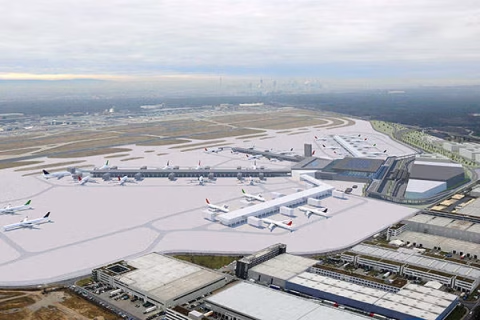
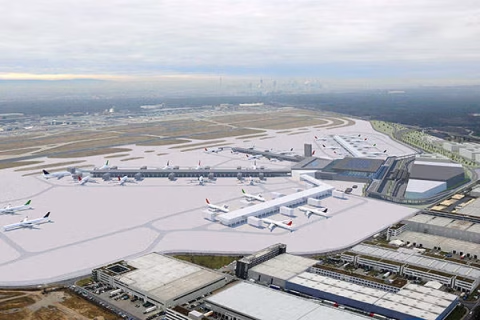
Frankfurt Airport’s Terminal 3 officially opened on April 23, 2026, representing the culmination of one of the largest privately funded airport infrastructure investments in European history at a total cost of €4 billion. Operated by Fraport AG, the new terminal spans 176,000 square metres and is structured around three operational piers, designated G, H and J, with a fourth pier, K, already provisioned in the master plan to raise total annual capacity from the current 19 million passengers to 25 million should demand require it. The seven-level main terminal building was designed by Frankfurt-based architect Christoph Mäckler, whose concept treats the terminal as an urban environment rather than a transit facility, with its interior organised around pedestrian streets, open squares and a dramatically undulating reflective steel ceiling in the main post-security marketplace. A phased airline migration programme will see all 57 carriers currently operating from Terminal 2 relocate to the new building across four stages concluding June 9, 2026, with SkyTeam and Oneworld alliance members among the first to move. Airlines making early transitions include Delta Air Lines, Korean Air, Cathay Pacific, China Airlines, Emirates, Etihad Airways, Qatar Airways, Saudia and Vietnam Airlines. Terminal 1 carriers, including Lufthansa Group and its Star Alliance partners, will remain in their existing terminal. The terminal is connected to the wider airport complex by an extended SkyLine automated people mover, which links Terminal 1 and Terminal 3 in approximately eight minutes.
Frankfurt Airport Terminal 3’s opening arrives at a moment that tests a fundamental assumption the European airport industry has carried for much of the past decade: that investment in premium passenger experience and commercial activation can offset the cost pressure created by high labour costs, energy prices and the long post-pandemic recovery of business travel. Frankfurt’s performance in 2025, at 57.5 million total passengers and still roughly 10% below pre-pandemic levels primarily due to Germany’s domestic cost environment, illustrates the specific challenge Fraport faces compared to European hubs like Istanbul, Amsterdam and Paris that have recovered more fully. Terminal 3 is, in part, a structural response to that gap: by concentrating the airport’s international long-haul alliances into a purpose-built, technologically advanced and commercially sophisticated environment, Fraport is repositioning Frankfurt as a premium transit hub rather than simply a high-volume throughput facility. The CT scanner security lanes that allow passengers to keep liquids and electronics in their bags are now fairly standard across new European terminal builds, having been pioneered at Heathrow and rolled out across Schiphol and CDG, but the retail activation model at Terminal 3 is genuinely differentiated.
Similar modernization efforts are also underway at other German airports, including Berlin’s Brandenburg Airport Terminal 2, which has completed construction as part of the capital’s wider strategy to expand passenger handling capacity and improve operational resilience. The Liquor, Tobacco and Confectionery Beacon, a cross-category activation concept operated by Frankfurt Airport Retail GmbH through its partnership with Gebr. Heinemann, is an attempt to move away from the brand-silo model that has dominated airport duty-free for thirty years and toward a curated, experiential retail format that encourages longer dwell time and cross-category spending. Whether this model works at scale will be closely watched across the European airport retail industry, because Frankfurt’s passenger mix, spanning long-haul leisure, connecting business travellers and European short-haul, is complex enough that a single retail format rarely maximises spend across all segments simultaneously.
Terminal Layout, Technology Integration and Retail Offer
- 176,000 m² total terminal area across a seven-level main building and three piers (G, H, J)
- Pier K provisioned in the master plan to expand capacity from 19 million to 25 million passengers annually when required
- 21 security lanes equipped with CT scanners: passengers may retain liquids and electronics in carry-on bags during inspection
- Fully automated baggage management system designed to minimise human intervention, reduce wait times and cut sorting errors
- SkyLine automated people mover extended to connect Terminal 1 and Terminal 3 in approximately eight minutes
- Retail space: more than 3,000 m² of duty free and travel retail spanning Schengen and Non-Schengen zones, operated by Frankfurt Airport Retail GmbH (joint venture: Fraport AG and Gebr. Heinemann)
- Core duty free and travel value store: more than 1,700 m² in the Non-Schengen zone
- Retail anchor concept: the Liquor, Tobacco and Confectionery Beacon, a cross-category activation installation featuring a central LED structure of 132 tiles with tasting areas, product displays and gifting options; launch partners include Henkell Freixenet, Diageo, Godiva and Davidoff
- Branded boutiques: Hugo Boss, Polo Ralph Lauren, Montblanc, CHRIST, FALKE, LONGCHAMP, TUMI, Victoria’s Secret, Sunglass Hut, CAPI Electronics, Gatezero (street culture and pre-loved fashion), Germany On My Mind
- Dining highlights: EL&N London, Sophia Loren Restaurant, Origin Bar and Eatery, Brot. (Axel Schmitt), Asia Street Cooking, Burger King, Haferkater, Mainbissen, Zigolini, Brewgate, Brew’d, Espresso House
- SkyTeam Lounge: 550 m² flagship lounge in the Non-Schengen international zone, level 4; capacity for 126 guests; showers, soundproof phone booth, relaxation area, panoramic airfield views, QR-code digital menu with on-demand hot cooking; access for Business/First Class passengers and SkyTeam Elite Plus members
- 8,500 parking spaces added to the airport complex
- Artist in Residence: Frankfurt-based Tobias Rehberger, with installations themed around transition; additional pieces to be added over the coming year
- Digital retail engagement: augmented reality QR code game allowing passengers to discover virtual Frankfurt landmarks within the retail space, with checkout rewards
Project Fact Sheet
- Project Name: Frankfurt Airport Terminal 3
- Owner/Operator: Fraport AG
- Architect: Christoph Mäckler Architekten, Frankfurt
- Total Investment: €4 billion (privately funded)
- Gross Floor Area: 176,000 m²
- Levels: Seven (main terminal building)
- Piers: G, H, J (operational); K (future expansion provision)
- Initial Annual Passenger Capacity: 19 million
- Expansion Capacity (with Pier K): 25 million passengers annually
- Location: Frankfurt Airport southern zone, Frankfurt am Main, Germany
- Official Opening Date: April 23, 2026
- Airline Migration Programme: 57 airlines relocating from Terminal 2 in four stages, concluding June 9, 2026; Condor to follow in summer 2027
- Initial Airline Alliances: SkyTeam and Oneworld (first movers); examples include Delta Air Lines, Korean Air, Cathay Pacific, China Airlines, Emirates, Etihad Airways, Qatar Airways, Saudia, Vietnam Airlines
- Security Technology: 21 CT scanner lanes (liquids and electronics may remain in carry-on luggage)
- Baggage System: Fully automated management system
- People Mover: SkyLine extended to link Terminal 1 and Terminal 3 (approximately eight minutes travel time)
- Retail Operator: Frankfurt Airport Retail GmbH (joint venture: Fraport AG and Gebr. Heinemann)
- Total Retail Area: more than 3,000 m² (Schengen and Non-Schengen zones)
- Lounge: SkyTeam Lounge, 550 m², 126-guest capacity, Non-Schengen level 4
- Parking Added: 8,500 spaces
Project Team
- Owner and Operator: Fraport AG — Frankfurt-based airport operator and majority shareholder of Frankfurt Airport; listed on the Frankfurt Stock Exchange; operator of airports in Peru, Greece and other international markets in addition to its German home base
- Architect: Christoph Mäckler Architekten — Frankfurt-based architectural practice led by Professor Christoph Mäckler; responsible for the terminal’s urban design concept, facade, interior layout and pier configuration
- Artist in Residence: Tobias Rehberger — Frankfurt-based contemporary artist; responsible for transition-themed installations throughout the terminal, including works bearing phrases such as “Say Hello To Goodbye”; additional pieces to be installed through 2027
- Retail Joint Venture Operator: Frankfurt Airport Retail GmbH — joint venture between Fraport AG and Gebr. Heinemann responsible for all duty free and travel retail operations across Terminal 3
- Retail Partner: Gebr. Heinemann — Hamburg-based global travel retail and duty free operator; managing partner in the Frankfurt Airport Retail GmbH joint venture
- Director of Marketing, Gebr. Heinemann: Sören Borch — overseeing the Beacon activation concept and cross-category retail strategy in the Non-Schengen zone
- Member of the Executive Board, Fraport AG (Retail and Real Estate): Julia Kranenberg — responsible for the commercial and retail strategy of Terminal 3; provided public commentary on the airport’s shift toward an experience-led rather than throughput-led passenger environment
- State Government: Hesse State Government — represented at the inauguration ceremony alongside federal and city political stakeholders
- City of Frankfurt: represented at the inauguration ceremony marking the terminal’s significance to Frankfurt as a global aviation hub


